
HERITAGE OF JAJPUR DISTRICT
Once Jajpur District was a great centre of art and culture in ancient Odisha. This district is declared as a heritage district ‘Biraja Khetra’ is one of the ancient cities of Odisha rich in archaeological remains .It is reputed to be one of the important Tantra Khetras in the state. The ancient monuments like Biraja Temple, Lord Baraha Temple, Daswasamedhaghat, Jagannath Temple, Trilochaneswar Temple, Ratnagiri, and Udayagiri and so many other places of historical importance add tourist attraction. Jaipur is also known as Navigaya. People all over the state and neighboring state come here to offer
SRADDHA on the Bank of River Baitarini.
A land of rich and diverse artistic achievement, Jajpur’s art and culture are theproduct of a long historical process in which the spiritual, philosophical and the humane dimensions have merged to yield the finest effects of culture and civilized life.The cultural heritage of Jajpur is reflected in its vibrant Art forms
The district has village tradition of painting, architectures, sculpture, and handicrafts. The Jajpur school of painting has three streams such as Jhoti, Chita and Muruja.

Coming to fasts and festivals, in the month of Margasira women folk worship the Goddess Laxmi. It is the harvest season when grain is thrashed and stored. During this auspicious occasion the mud walls and floors are decorated with murals in white rice paste. These are called Jhoti or Chita and are drown not merely with the intention of decorating the house, but to establish a relationship between the mystical and the material, and thus being highly symbolical and meaningful. Folk painting in the tradition survives till today in all its pristine freshness. Throughout the year the village woman perform several rituals for the fulfillment of their desires.
Muruja is drawn on the floor with powders of different hues. white powder is obtained from the grinding of stone. Green powder is obtained from dry leaves, black from burnt coconut shells, yellow is obtained from petals of marigold flowers or turmeric and red from red clay or bricks. Muruja is generally drown during rituals in the form of Mandala. In the holy month of ‘Kartika’ women observe,penance and draw muruja designs near the Tulasi Chaura
Language Spoken In the District
Odia one of the oldest languages in the district and also the predominant language spoken by the people. However 10 percent of the inhabitants speaks Urdu and atleast 9 to 10 percent communicate with some variations having adivasi languages.
Art and Literature
From time immeorial Jajpur has remained the epi centre of cultural awakening.Besides that the district has immense contribution to odia literature.The prominent literary figures of the state like Abimanyu Samanta Singhar, Manjula Krushna Prasad Basu, Braja Sundar, Birupakshya Kar, dramatist Kamapal Mishra are son of the soil. Other prominent writer include Upendra Tripathy(children’s literature),essayist Baikuntha Nath Rath, and fiction writer Govind Das.
Chandikhole chandi Temple
Chandikhole is a town in Jajapur district, Odisha, India. The place has been named after Goddess Chandi worshipped by late monk Baba Bhairabananda Bramhachari who established the deity of Maa Chandi in one of the adjoining hills of Barunei full of dense forest and ferrocious animals in 1932.The accommodation facility can be availed at Chandikhol and Cuttack by hiring Hotels and Lodges. For financial purpose, the nearest bank located to this tourist place is S.B.I and a few nationalized banks which are located at Chandikhol. The common languages spoken in the area are Odia, Hindi and English. S.C.B Medical college Cuttack is nearer to the spot for accessing medical facilities. People wear light cotton in summer and woolen in winter.
ByAir
Bhubaneswar -70 KM
ByRoad
From Chandikhole Chhak -5 KM
By Road
From DU Public School : 5 KM
ByTrain
Dhanmandal -3KM
Biraja Khetra
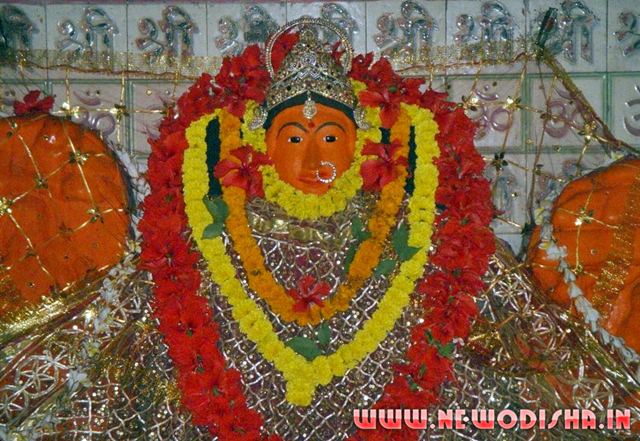
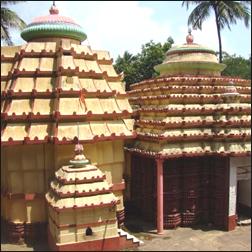
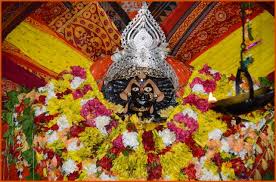
Biraja Temple or Viraja Kshetra , is one of the ancient Hindu temples located in the Jajpur district of Odisha, India. This present temple was built in 13th century. It is situated in the Jajpur township which is nearly 125 KM north from Bhubaneswar. The main idol is Devi Durga who is worshiped by the name Viraja.The idol is having two hands, in one hand she pierces the chest of Mahishasura with a spear and in other hand she pulls the tail of the Mahishasura.The Durga idol is standing on Lion in one leg and other leg is on Mahishasura chest.The Mahishasura is depicted as a Buffalo, not as regular human demon.The crown of Devi has symbol of Ganesha, Crescent moon and a Shivalinga.The temple covers a large area, and it has several Shiva linga and other deities. Jajpur is also known as Viraja Kshetra or Biraja Peetha.According to Skanda Purana,utkala khanda it washes all rajo guna of pilgrims. So called as Viraja or Biraja kshetra.The accommodation facility can be availed at Jajpur Road by hiring Hotels and Lodges. For financial purpose, the nearest bank located to this tourist place is S.B.I and a few nationalized banks which are located at Jajpur town. The common languages spoken in the area are Odia, Hindi and English. Head Quarter hospital Jajpur is nearer to the spot for accessing medical facilities. People wear light cotton in summer and woolen in winter.
ByAir
Nearest Airport-125 km
ByRoad
Jajpur Town – Distance 32 KM
ByTrain
Nearest Railwaystation-J K Road- 30KM
Ratnagiri
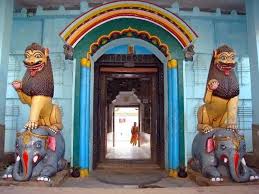
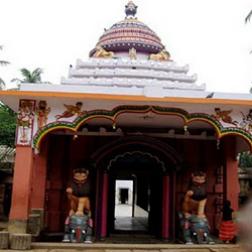
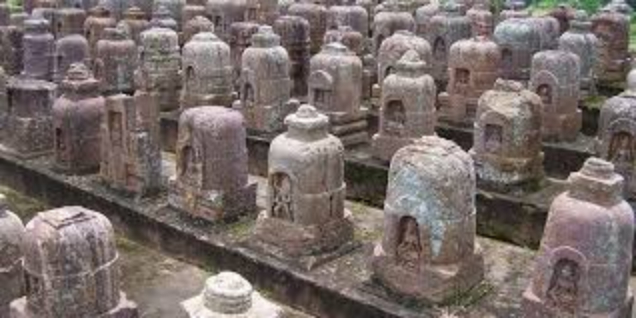
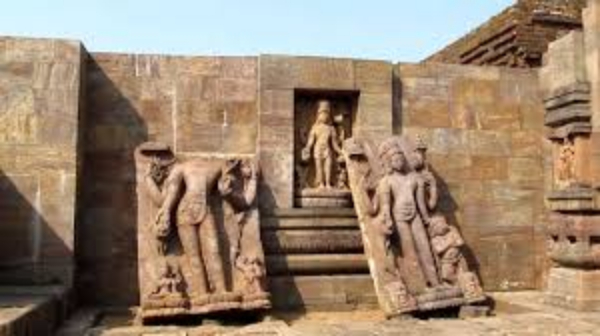
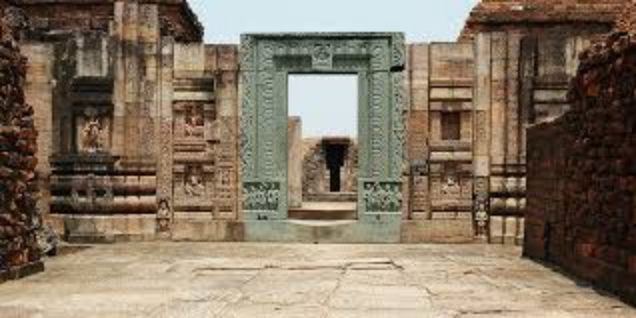
Archaeological museum at Ratnagiri is one of the important site museums of Archaeological Survey of India, built on the northern crest of the Ratnagiri village, of District Jajpur in Odisha.
ByAir
Nearest Airport-Bhubaneswar 90 km
ByRoad
Chandikhole Chhak -20KM
ByTrain
Dhanmandal(25KM)
Mahavinayak Temple is a major pilgrimage center in Chandikhole in Jajpur district in the Indian state of Odisha. It is one of the oldest Ganesha temples in the state. Five gods – Shiva, Vishnu, Durga, Surya and Ganesha – are worshiped as one deity in a single Garbhagriha or sanctum sanctorum there.
Multiple deities
Because five gods are worshiped as one deity in the temple, there is no pahada in there. Normally, Hindu temples close after pahada, which is sleeping time for the gods. Since Shiva and Vishnu are worshiped in a single sanctum sanctorum, leaves of both Bilva (Aegle marmelos) and Tulasi (Holy Basil) are used in prasadam.
Anna (rice) prasadam is offered instead of Batula Bhoga.
Location
The Mahavinayak Temple is located in Chandikhole in Jajpur district.
The first adjoining foothill base hosts the temple of Goddess Chandi, and in the second foothill base is the temple of Mahavinayak. Both have perennial springs (Golden Spring) with pucca swimming ponds for bathing. In the middle of the hill, just above the Mahavinayak Temple, is another temple dedicated to Maa Banadurga.
Legends
The Mahavinayak Temple[4] is a place of mythological and historical importance. This temple was constructed by the kings of the Keshari Dynasty of Odisha during the 12th century.[5]
The goddess Rati,[6] the wife of Kamadeva, is worshiped there for her devotion that led to the release of her husband from the curse of the god Shiva. While she was praying to Ganesha, five hands simultaneously stretched out toward her to receive her offering, putting her in a dilemma. She then prayed to Bramha who clarified that the five gods, Ganesh, Sun, Vishnu, Shiva and Durga, were pleased with her prayer and simultaneously stretched their hands to receive her offering. Kamadeva was released thereafter, and that day a large granite stone emerged from the earth, containing the divine power of the five gods.
This place is also related to Mahabharat legends. The Baruna hill area was the capital of Yudhisthira. From this place, he left for heaven by handing the royal charges of his empire to a teli (an oilman whom he saw first before dawn) who later became the king. His palace was named Teligarh and the remains of his palace can still be seen on the opposite side of the temple. During the Mahabharat battle, mother Kunti also offered Golden Champa flower to Lord Shiva from this place for the victory of her sons.
It is also said that the detached head of Lord Ganesh fell at this location.
Festivals
Festivals, such as Shiva Ratri, Makar Sankranti and Raja, are celebrated here. Shiva Ratri is celebrated for five days with Yagna and Homa every year. People visit each Monday. In the month of Shravana, Shiva devotees offer holy river water to fulfill their wishes.
CHHATIA JAGANNATH TEMPLE
Chhatia Bata or Chhatia Jagannath Templeis a Hindu temple in the village of Chhatia, between the towns of Cuttack and Chandikhol in Odisha, in eastern India. It is devoted to Jagannath and associated with Kalki, the avatar of Vishnu.
Hadidas mentions this temple in the saga Maalika, predicting that “on a day when all living animals and humans will die and fish will play at the steps of Puri temple”
Chhatia Bata in Odisha is the revered resting place of Mahapurusha Saint Hadidas, the visionary author of the prophetic text Maalika. This sacred scripture, predicts future world events with remarkable accuracy. It foretells the end of Kaliyug, when Lord Vishnu will incarnate as Kalki Avatar to cleanse the world of sin.


According to the prophecy, Lord Jagannath, Lord Balabhadra, and Devi Subhadra will leave their abode in Puri and relocate to Chhatia—the only land that will remain untouched by the rising sea.
Handicrafts
During pre-independence period, many cottage industries like spinning wheel centre ,leather processing ,bee-keeping etc spread through the ‘SEBA GHARA’ founded by Gopabandhu Chaudhury and Rama DeVi. The indigenous thread of Ramachandrapur spinning wheel centre was used in various Khadi & Rural development institutes of Odisha. The hand-spin clothes produced in Bari,Baliapal,Dharpur,Aurangabad,Kimbhiriapal,Bainsiria,Malda,Gobindabati villages gained popularity all over the district. Khadi clothes, scarf’s ,shirting pieces etc being woven at Ramachandrapur met the needs of the locality and were sent to several places of Odisha .Through this centre,thread,spinningand khadi weaving centres werefoundedin
Rampa,Atira,Kaipara,Haldibasant,Gammu,Krushnanagar,Raipur,Bhanra,Areikana,Dharpur villages. Weavers of Chhatisdebil produced lungi,scarf etc and sold them at Biraja hat and at various places of Jajpur.The Weaver association of of Chhatisdebil is playing an active role in hand-spun-cloth-production till today. Weaver association were founded in Markandapur,Jajpur ,Sudhabobinda ,Badsuar,Sanasuar,Kapasi,Kapila villages of Jajpur block and the process of cloth production continued. Jahna weavers co-operative society Ltd was founded in Jahna panchayat in 1973.About 400 weavers from different villages have been enrolled as member of this society. Weavewrs of Gopalpur in Dharmasala Police station weave Pata,Matha,tusser thread Dhotis,sarees,Chadar,scarf, suiting pieces and tusser wall clothes exportable to foreign countries. From here,tusser-made clothes are exported abroad via Bhagalpur of Bihar,Champa of Madhya Pradesh and Kolkota of west Bengal. After 1964,Government made plans to provide encouragement to weavers through cooperative societies, but even after five decade, the plans have not made spectacular achievement.
During Pre-independence era,the gold-silver-filigree works Bari, Thakurpatana, Baliapal,Arual,Mahammadpur, Chandanpur,Haripur,Gahalpal villages gained popularity not only in odisha,but also in the neighbouring state of West Bengal.
Stone-sculptors of Ratnagiri,Aliabad & adjacent villages used to make this flowers, several scenes of Kurukhetra battle, images of Rajas,Maharajas & Greatman ,Ashok chakra in black granite,partially red and marble stones. At present these sculptors of Panchu pandav,Balichandrapur,Bandareswar areas beside chandikhole-paradeep express Highway are engaged in making such lots of rare images .About 100 Maharana families of Shukhuapara village in Barchana- Block Bikramtiran-panchayat have been making various stone images for the last 200 years.
Even the adivasis and scheduled caste people of the village are engaged in stone-image making activities. State handicraft awardees Ranjan Maharana belongs to this village. Central govt awardees Maheswar Ojha and Satyananda Maharana conferred with squad of Honour in New Delhi have indeed brought glory to Jajpur district.
Brass-metal workers of Kundapatana ,Narasinghpur villages and kaincha workers of Kamagad are widely acclaimed all over the state.
Paramananda Sahu of Patapur Badabarisahi village of Dharmasala is famous in the state for clay image making craft.His son Durgacharan Sahu has countrywide name and fame Images of Gopabandhu Das,Harekrushna Mahatab,Biju Pattanayak built by him have been installed in several places of Odisha.
Baban Charan Sahu of Khanditara village in Dharmasala has kept alive the great Indian culture heritage through his clay image making craft.He got inspiration from korei-Barda village craftsman Bhakta Charan Pattanayak ,underwent training Kolkata kumatoli and founded Nandankanan Kala Bhavan.He displayed Banki Rani Suka Dei,Khurda paika war, cosmic leelas of Lord Jagannath , Jalianawalabagh massacre ,Raja Harishchandra,Dusmant-Shakuntala,Yasoda’s curd -churning, Sita’s eternal sleep underground Thread-Spinning at Gandhi’s Sabrmati ashram,Chatrapati Sivaji’s life story ,alongwith many mythological,historical,current events in the form of clay-images and was applauded and awarded by dignitaries like Sharada Mukharjee,Narasimha Rao,Sunil Shastri,K.Basant Naidu,Ranganath Mishra, Gyani Jail singh ,Mohanlal Sukhadia.